Part 2 of the bringing instagram roundups to my ownership. You can see part 1 over here. If you want to see the memes, head over to Instagram.

Here we go.

April

The Grapes of Wrath by John Steinbeck

Incredibly written if deeply depressing. I’m glad I started my Steinbeck journey with East of Eden, because this didn’t really take you on the up journey, just the down. But what a journey into the depths it is. In this house, we stan Steinbeck.
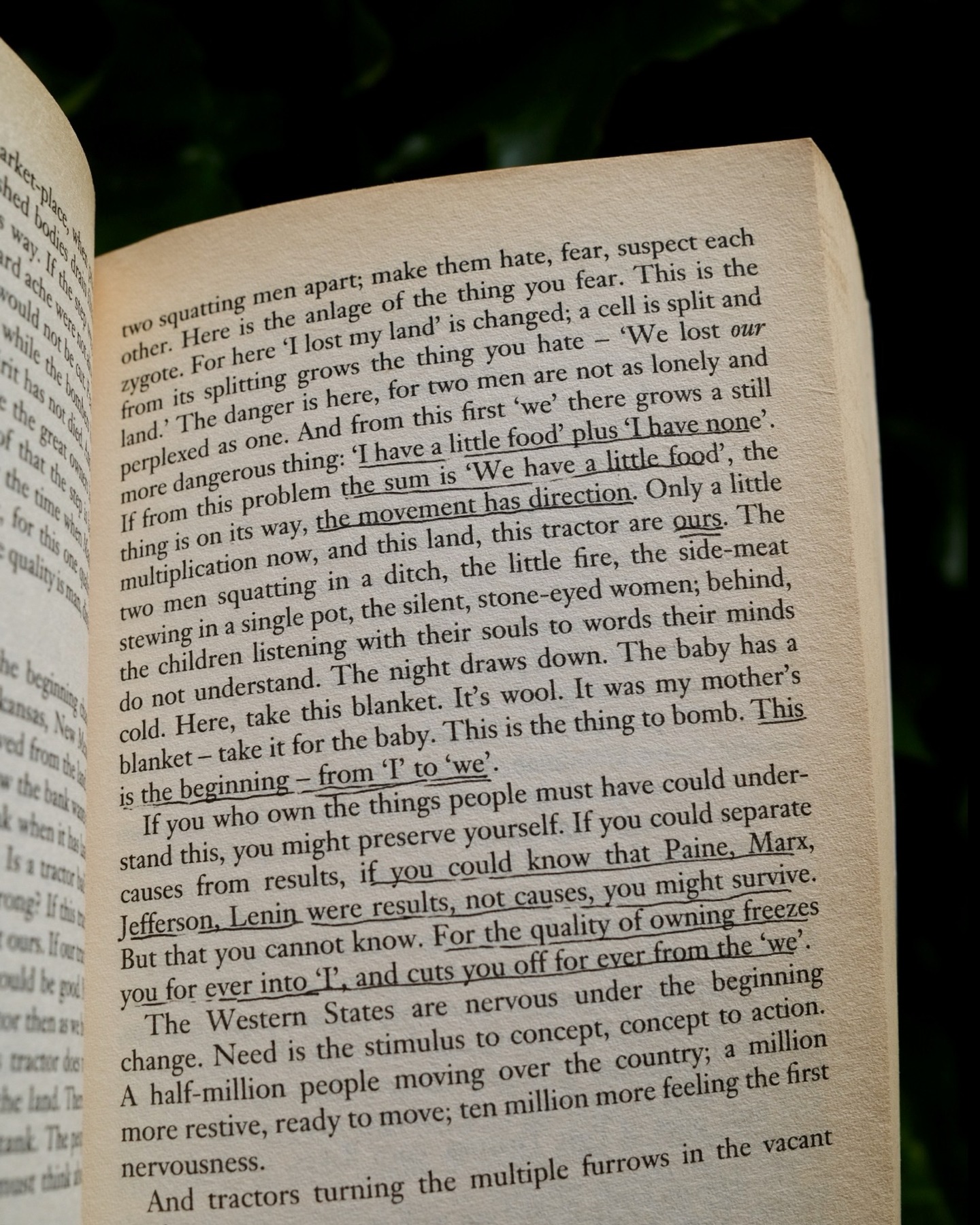
The danger is here, for two men are not as lonely and perplexed as one. And from this first 'we there grows a still more dangerous thing: I have a little food plus I have none. If from this problem the sum is We have a little food, the thing is on its way, the movement has direction. Only a little multiplication now, and this land, this tractor are ours. The two men squatting in a ditch, the little fire, the side-meat stewing in a single pot, the silent, stone-eyed women; behind, the children listening with their souls to words their minds do not understand. The night draws down. The baby has a cold. Here, take this blanket. It’s wool. It was my mother’s blanket - take it for the baby. This is the thing to bomb. This is the beginning - from I to we. If you who own the things people must have could understand this, you might preserve yourself. If you could separate causes from results, if you could know that Paine, Marx, Jefferson, Lenin were results, not causes, you might survive. But that you cannot know. For the quality of owning freezes you for ever into I', and cuts you off for ever from the we.
The Grapes of Wrath

Conflict Is Not Abuse: Overstating Harm, Community Responsibility, and the Duty of Repair by Sarah Schulman

This book properly challenged me. Of course, we read to learn and most things give you a little push but this was a Big Old Shove. Incredible.

Giovanni’s Room by James Baldwin

Crushing. Like pressing your finger on a bruise. Even if one must look aside from the way he writes about women and trans people in this book.
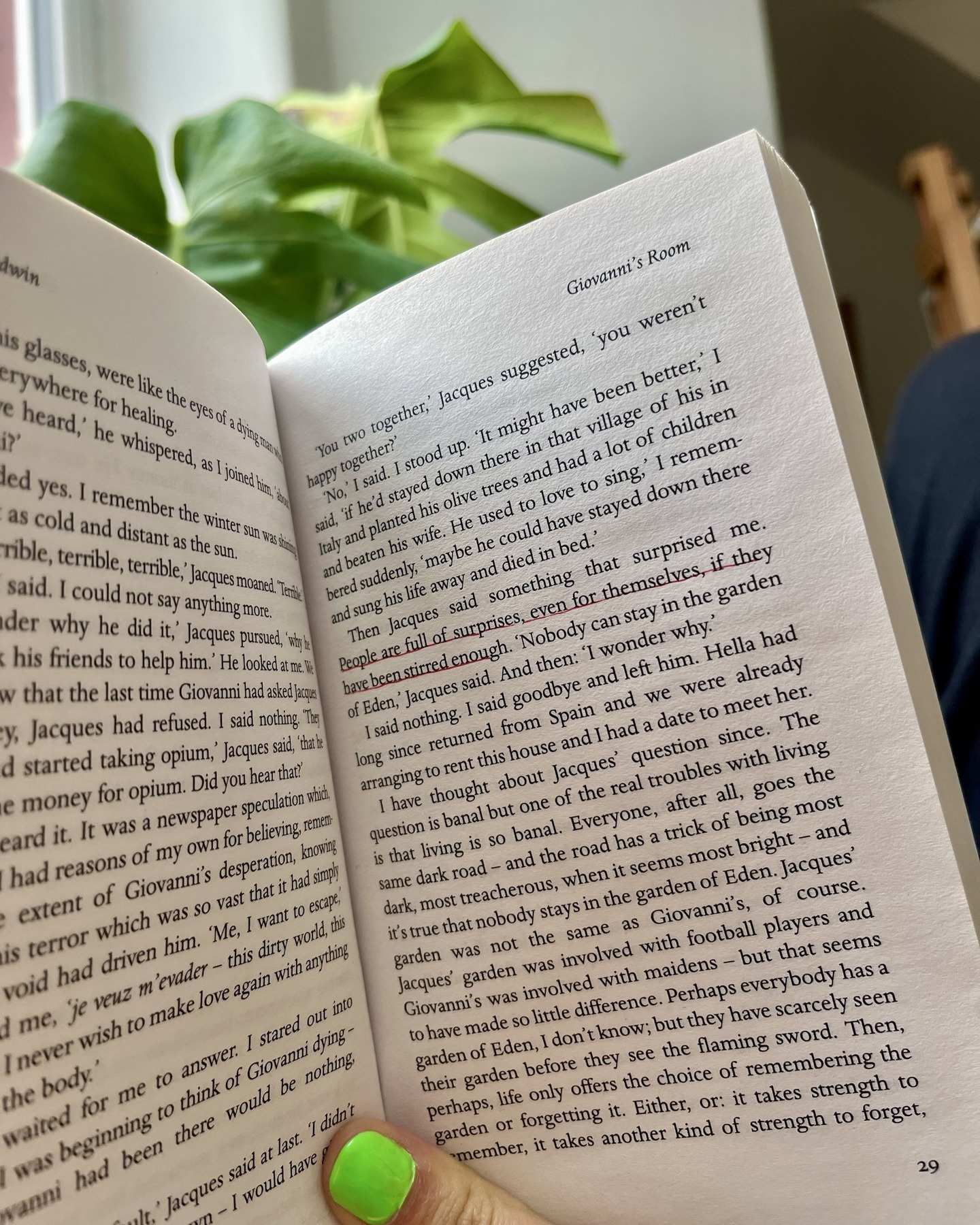
People are full of surprises, even for themselves, if they bave been stirred enough.
Giovanni’s Room

House of Day, House of Night by Olga Tokarczuk

I read Flights years ago with my book club, and found it difficult. I like narrative. Drive your Plow is one of my favourite novels of all time. This one was more like Flights, but I think I appreciate form and pure craft more now that I’m a baby writer and so I did like this. I did like the way it shows that borders are stupid and made up. Anything that’s made up can be unmade.

Alchemised by SenLinYu

A little fantasy escapism. I had no idea about the whole Manacled lore until I got to the end and then I felt bad for the last line of the book not f-ing me up the way it apparently did to everyone online.

Interrogating the Global Social Challenges, ed. Kevin Gillan, Vanessa May

An edited collection with chapters by tons of people in my department, including both my supervisors. Entry-level introductions to various themes. I read to get to know the department better.

Livestock/Deadstock: Working with Farm Animals from Birth to Slaughter by Rhoda M. Wilkie

Only one animals book this month! What have I been doing? Oh yes, I got my ethics approval. Research starting. If you know a farmer, introduce me :)

May

Life Beside Itself: Imagining Care in the Canadian Arctic by Lisa Stevenson

This is a masterclass in ethnographic writing. Beautiful, heart-wrending, quietly groundbreaking. It has nothing to do with my PhD research but sometimes you just gotta read things that inspire. From her research integrity to writing craft, 10 out of 10.

Governing Bodies: A Memoir, A Confluence, A Watershed by Sangamithra Iyer

There is lots to recommend about this book; it’s reflective and meandering and often poetic. I think the personal-essay-slash-memoir is one of my favourite genres. However, Iyer does this moral superiority thing that I find quite grating. The bits on family and belonging are lovely.

The Covenant of Water by Abraham Verghese

Generational epic set in South India. Rich and compelling characters and a very interesting premise with the water thing (no spoilers). I confess, I was more drawn to the early characters in the book (Ammachi) and a little dissatisfied with the resolution of the water thing… a little too ā€˜hymn to progress’ for my taste. But it’s a fantastic narrative and if you are willing to take on a ~750pager (or 31hr audiobook, in my case) then I do recommend.

June

Anti-Oedipus: Capitalism and Schizophrenia by Gilles Deleuze and FƩlix Guattari

What a book! I loved reading this so much, despite (or maybe because) of how much of a head-fuck it is. I listened to 10 lectures on the first chapter alone, and for a fleeting moment thought I understood a Body Without Organs.
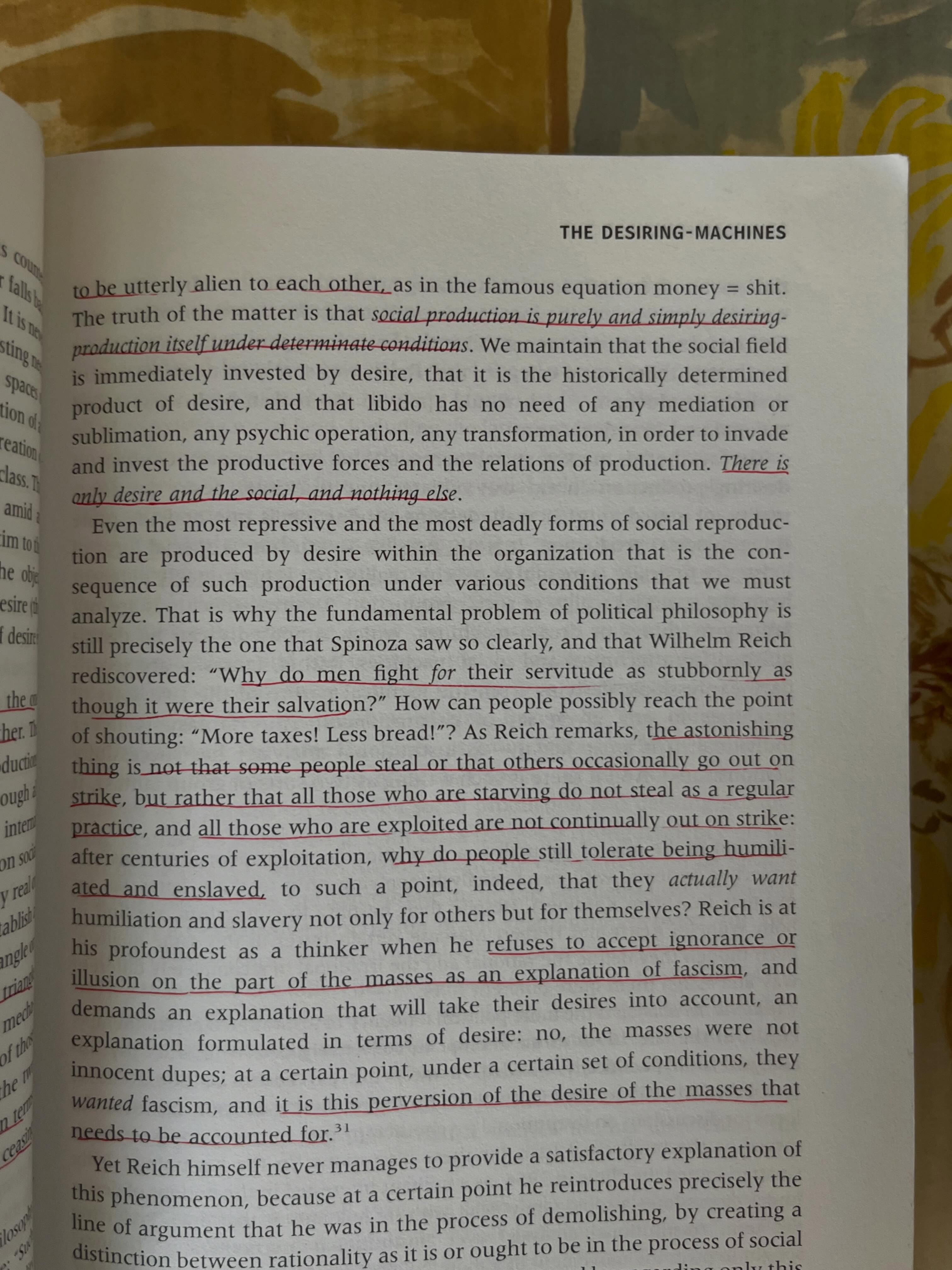
There is only desire and the social, and nothing else. Even the most repressive and the most deadly forms of social reproduction are produced by desire within the organization that is the consequence of such production under various conditions that we must analyze. That is why the fundamental problem of political philosophy is still precisely the one that Spinoza saw so clearly, and that Wilhelm Reich rediscovered: Why do men fight for their servitude as stubbornly as though it were their salvation? How can people possibly reach the point of shouting: More taxes! Less bread!? As Reich remarks, the astonishing thing is not that some people steal or that others occasionally go out on strike, but rather that all those who are starving do not steal as a regular practice, and all those who are exploited are not continually out on strike: after centuries of exploitation, why do people still tolerate being humiliated and enslaved, to such a point, indeed, that they *actually want humiliation* and slavery not only for others but for themselves? Reich is at his profoundest as a thinker when he refuses to accept ignorance or illusion on the part of the masses as an explanation of fascism, and demands an explanation that will take their desires into account, an explanation formulated in terms of desire: no, the masses were not innocent dupes; at a certain point, under a certain set of conditions, they wanted fascism, and it is this perversion of the desire of the masses that needs to be accounted for.
There is only desire and the social, and nothing else.

Sula by Toni Morrison

Morrison will pull out your heart, grate it up into little slivers, mix in as much devastation as possible, and then shove it back in your chest cavity to fester. I remember this feeling from when I read Beloved from start to finish in one sitting on a redeye transatlantic. Some of us like this feeling.

Forest of Noise: Poems by Mosab Abu Toha

Poems about life in Gaza, from the bombs to moments with family. Painful and raw and beautiful. A free Palestine in our lifetime, inshallah.

Housekeeping by Marilynne Robinson

I read this on recommendation and in lieu of a review, you get excerpts of the email I wrote to the recommender.
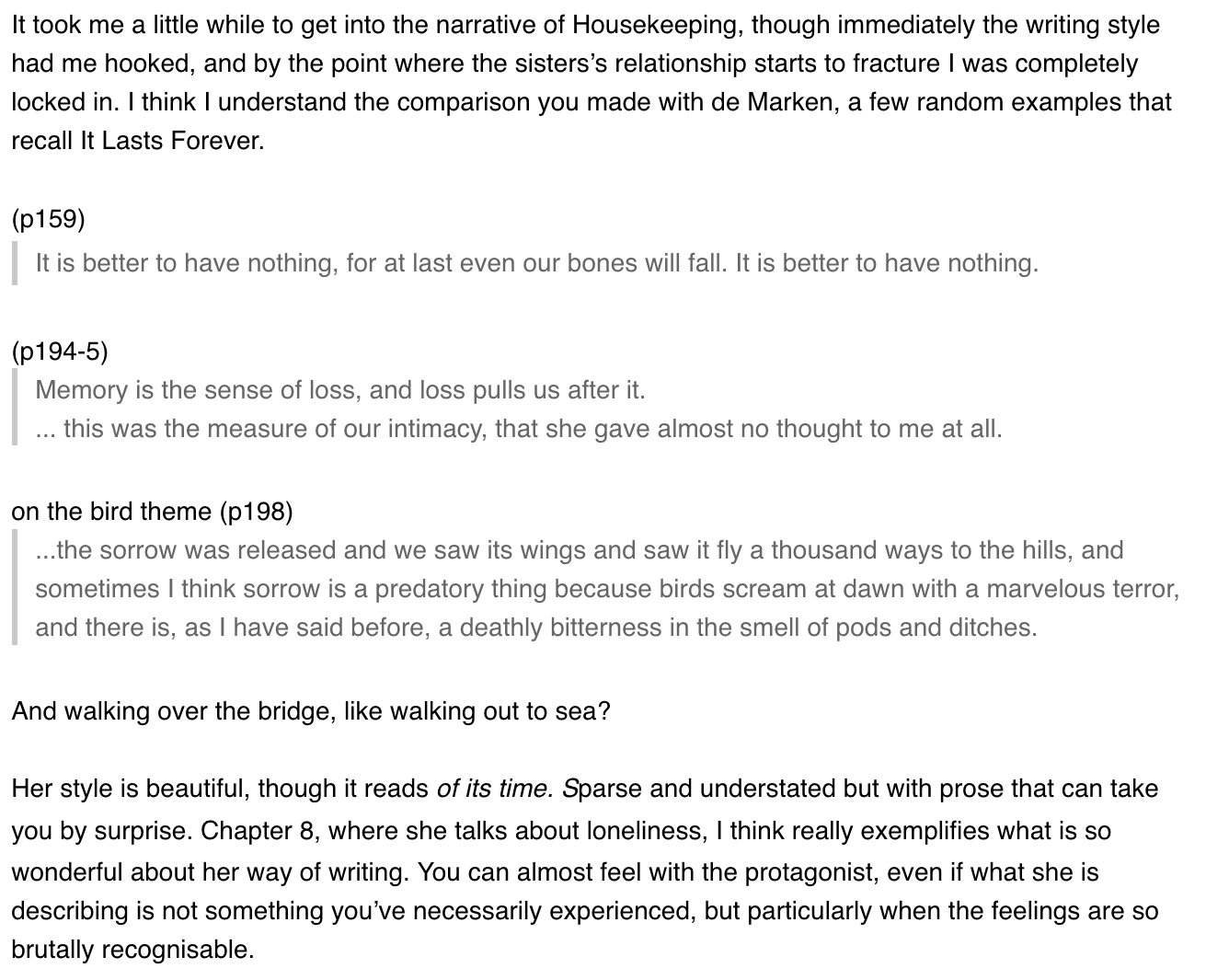
It took me a little while to get into the narrative of Housekeeping, though immediately the writing style had me hooked, and by the point where the sisters's relationship starts to fracture I was completely locked in. I think I understand the comparison you made with de Marken, a few random examples that recall It Lasts Forever.
(p159) It is better to have nothing, for at last even our bones will fall. It is better to have nothing.
(p194-5) Memory is the sense of loss, and loss pulls us after it.
... this was the measure of our intimacy, that she gave almost no thought to me at all.
on the bird theme (p198)
...the sorrow was released and we saw its wings and saw it fly a thousand ways to the hills, and sometimes I think sorrow is a predatory thing because birds scream at dawn with a marvelous terror, id there is, as I have said before, a deathly bitterness in the smell of pods and ditches.
And walking over the bridge, like walking out to sea?
Her style is beautiful, though it reads of its time. Sparse and understated but with prose that can take you by surprise. Chapter 8, where she talks about loneliness, I think really exemplifies what is so wonderful about her way of writing. You can almost feel with the protagonist, even if what she is describing is not something you've necessarily experienced, but particularly when the feelings are so brutally recognisable.
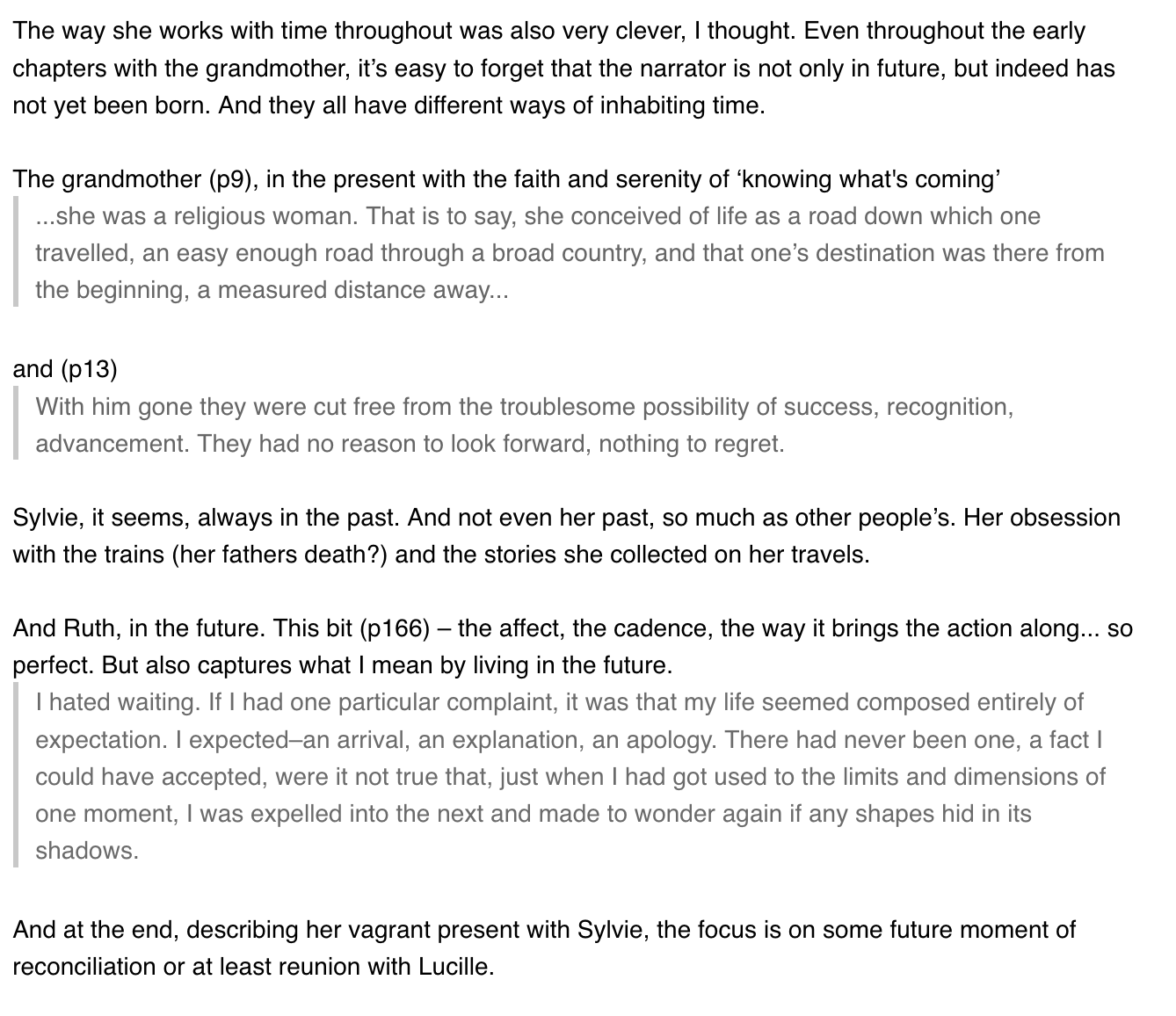
The way she works with time throughout was also very clever, I thought. Even throughout the early chapters with the grandmother, it's easy to forget that the narrator is not only in future, but indeed has not yet been born. And they all have different ways of inhabiting time.
The grandmother (p9), in the present with the faith and serenity of 'knowing what's coming' ...she was a religious woman. That is to say, she conceived of life as a road down which one travelled, an easy enough road through a broad country, and that one's destination was there from the beginning, a measured distance away...
and (p13)
With him gone they were cut free from the troublesome possibility of success, recognition, advancement. They had no reason to look forward, nothing to regret.
Sylvie, it seems, always in the past. And not even her past, so much as other people's. Her obsession with the trains (her fathers death?) and the stories she collected on her travels.
And Ruth, in the future. This bit (p166) - the affect, the cadence, the way it brings the action along... so perfect. But also captures what I mean by living in the future.
I hated waiting. If I had one particular complaint, it was that my life seemed composed entirely of expectation. I expected-an arrival, an explanation, an apology. There had never been one, a fact I could have accepted, were it not true that, just when I had got used to the limits and dimensions of one moment, I was expelled into the next and made to wonder again if any shapes hid in its shadows.
And at the end, describing her vagrant present with Sylvie, the focus is on some future moment of reconciliation or at least reunion with Lucille.

Project Hail Mary by Andy Weir

The movie was sweet and cute, the book much the same if a little less saccharine and a little more ’science’. It’s not on the nerd level of The Three Body Problem but good if you like a little math with your entertainment. The flaws of the main character more central in the book.

Bury Our Bones in the Midnight Soil by V.E. Schwab

Sapphic vampire brainrot but make it stressful.

The Party by Tessa Hadley

Mid.

Qualitative Researching by Jennifer Mason

One can, in fact, read the word ā€œepistemologyā€ too many times. This is one of the better methods handbooks though.